01 November 2022

Any Excuse to get into the Air

 Welcome back folks. 

I grew up with the sound of aeroplanes flying over the house, as we lived five miles away from the runways of Heathrow Airport. Not only that but my father worked for BOAC / British Airways so aviation ran in my family. At the age of 15 I joined the Air Training Corps ( now known as RAF Air Cadets) so that I could have a go at flying with the Air Experience Flight. Also when I was 14 I went on a student exchange to Germany, and while there I was lucky enough to have a flight in a glider over the Luneburg Heath.

When I was sixteen the Commanding Officer of my Air Cadet squadron phoned me up one weekend and asked me if I would like to go to White Waltham Airfield and take the Gliding Proficiency Test, which culminated in three solo flights. Without hesitating I said yes, so throughout the summer of 1975 you could find me at the airfield undergoing training, in the rather old fashioned Kirby Cadet Mk3 ( T31 )  and Sedburgh two seater gliders.


A Sedburgh glider taking off with a winch launch

The seed had been sown and it was then that I wanted to somehow fly for a living. I didn't mind if it was with an airline, or in the RAF, I just had to fly. I then narrowed my choice down to cabin crew, as I didn't have the qualifications to become a pilot. From that time I focused my training and experience to getting the cabin crew job. After leaving school I enrolled at the local catering college at Slough, and gained City & Guilds in catering.

I got a part time job in a restaurant working my way from washing up to being Deputy Manager. I then went to work at Heathrow for an airline catering company, as Assistant Buyer, responsible for purchasing everything the company needed, from apples to diesel for the trucks. . My days were spent getting price quotes on the phone, then writing our orders onto self carbon paper for our Heathrow unit and getting the orders by fax from our Gatwick unit. Once the orders were placed and the prices quoted we then faxed the sheets back to the storeman at Gatwick. At the time fax machines were only just starting to be used so one sheet of paper would take about 5 minutes to send or receive, and had to be manually attached to the drum on the machine. This happened every week from Monday to Friday.

I worked there for about 18 months before leaving to work in America on a summer camp job, then applying to join the RAF on my return. Unfortunately due to being a civilian qualified course the RAF had to wait until there were enough applicants to form the course, before allowing me to enlist. In the 18 months I had to wait, I got a job as a Warehouseman with Marks and Spencer. Even then the desire to fly hadn't left me, so a work mate and I joined the Thames Valley Gliding Club at Booker Airfield, near High Wycombe, and started having lessons.

Before I could go solo again I was invited to enlist, so my gliding was put on hold. This state of affairs didn't last long though, because once I was at Portreath I would study Routine Orders to see of any courses available. Low and behold I noticed there was something called Joint Services Adventure Training, and one of the activities was Gliding. I had a quick chat to Sgt Clarke, and sounded him out on whether I could go or not. I explained I had already done some gliding, and was hoping to carry on. To my amazement he said it would be ok as far as he was concerned, but I would need permission from the Catering officer. With that I went to General Office for the application form, completed it and after handing in, waited for an answer.

About a month later I received the answer, and it was in the form of joining instructions to attend a course at RAF Bicester Gliding Centre. 


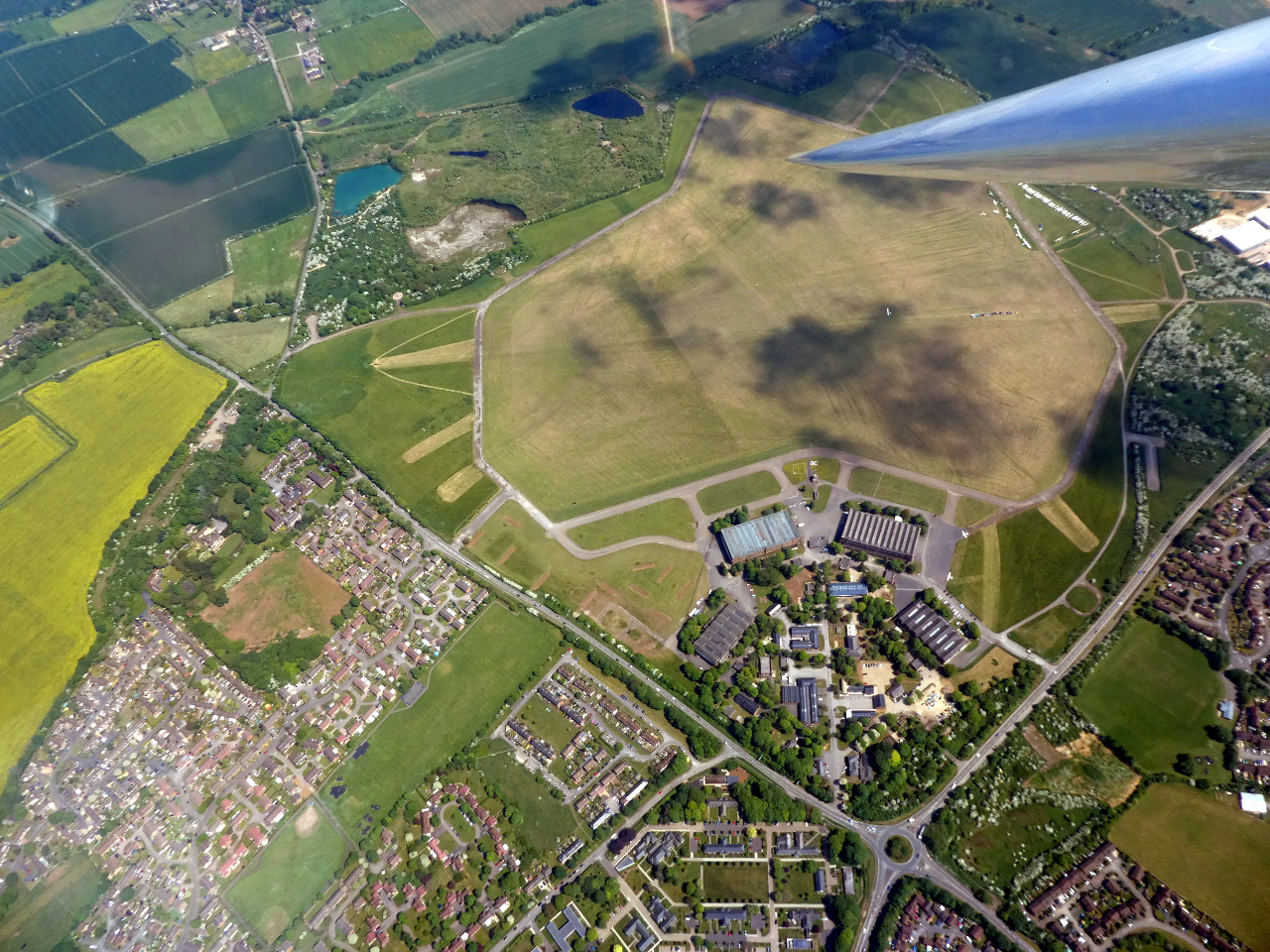
FLYING OVER THE AIRFIELD


As I didn't have a car at that point I had a rail warrant to travel to Oxford then a bus to the airfield. Once there the Centre staff would take us to the nearby Army Depot for accommodation, and picked us up each morning. I had a brilliant week at Bicester and wanted to take up the sport back in Cornwall. 

This is where I had a problem. I couldn't drive yet, so here was another incentive to pass my test. I discovered there were two places that I could learn to glide. HMS Heron at Culdrose had a club, which I could have joined as a serviceman, but Culdrose was quite a long way to drive. Much nearer to St. Mawgan was the civvy Cornish Gliding Club who were based at Trevellas Airfield, which was on the old WW2 RAF Perranporth site. 


Trevellas Airfield


I came across it when I started to explore Cornwall in my car. I drove up to the launch point and watched the goings on then started to chat to some of the members. The next time I came down, I joined the club and started to train, with the intention of going solo. I did get to some soaring with an instructor when the sea breeze  was blowing up against the cliff edge enabling us to use the ridge soaring effect. Unfortunately due to the airfield's close proximity to the sea the usual method of using thermals of warm air bubbles to remain airborne for extended flight didn't occur as the land couldn't warm up sufficiently to create the much needed thermals.

I wasn't happy with my progression towards solo flying as there weren't enough instructors at the club, or the weather wasn't good enough to fly. I also found that the cables the club used on the winch launches had a habit of breaking, which was great when you wanted to practice launch failures, but also meant there was a lot of down time while the cable was repaired. I persevered for a few months but in the end decided I would look for a better club later and carry on my training at that time. I had enough other things to keep me occupied anyway.

Although Portreath wasn't a flying station we did occasionally have someone fly in to the station. The first time that I can remember was when the Devon & Cornwall Police helicopter landed. The pilot came over for lunch in the mess. I'm not sure why he visited the airfield, but I got chatting to him while he was having his meal. Anyway one thing lead to another and he invited me and a couple of the mess staff for a quick flight in the helicopter. At the time in the early 80s they where using the French made Squirrel  helicopter so he could get three of us in the cabin


A Squirrel Helicopter similar to the one we flew in


So once the lunch time service had finished and before the chef started preparation of the airmen's' evening meal. Mick Vincent, myself and Bobby walked over to the helicopter with the pilot and climbed in. We strapped ourselves in and we took off. Unfortunately the weather wasn't great, and it started to rain. The pilot flew the helicopter to about 900 feet and he went slowly around the airfield boundary before the low cloud put an end to our joy ride.

About six months later we had some visitors to the airfield who were rather mad but enabled me to have another flight. The Parachute Regiment display team, called the Red Devils came down to Cornwall for some pre season training. Although Portreath wasn't an active airfield, it still had runways, even if they were not in a great condition. However the Red Devils used a small Britton-Norman Islander aircraft which was able to use rough runways, and had short take off capability.


One day the team came into the mess for lunch and as usual I got chatting to them about what they were doing in Cornwall. The warrant officer explained that some of the team were new so they needed to practice the routine they used at a location away from public gaze and with little aviation going on to get tin their way. As usual one thing led to another and I was invited to go up with them on their next flight that afternoon. Once I had cleared it with the Mick Vincent ( who was in charge that afternoon). I went out with them and the pilot. I sat in the co-pilot's seat at the front, while they got in the back with their parachutes strapped on.

There were no seats at the back so they all sat on the floor of the cabin. We took off and started climbing rapidly over the Cornish countryside and Redruth and Camborne. We eventually reached 12,000 feet and at that point the pilot eased back on the throttles to slow down enough for the paras to exit the aircraft. Over the noise of the engines, and the rushing air as they opened the door, I could hear them shouting and laughing their heads off as they jumped out together.

Now on the climb up I had been able to clear my ears by yawning. On this occasion I had broken an unwritten rule of not flying if you have a cold. I was so desperate to fly that I ignored the rule and went anyway. Once the paras had jumped out, the pilot put the Islander into a shallow dive to get back on the ground as quickly as possible. It was at this point I began to regret my decision to go up when I found I couldn't clear the pressure build up in my ears, and suffered excruciating pain around my sinus tubes. Because of my cold, the tubes were blocked which meant I couldn't relieve the pain by pinching my nose and blowing out. I kept blowing as hard as I could and eventually the tubes unblocked and I was able to clear the pressure build up. I learned my lesson that day, and later on when I was flying on VC10s if I had a really bad head cold I wouldn't hesitate to call in sick. Fortunately I only remember going sick once during my tour.   

The next day the Red Devils went to St. Mawgan to train so we didn't see them again. Unfortunately their day at St. Mawgan had a tragic end. Part of the display involved stacking themselves one above each other. This meant the parachutist who was above the guy below would wrap his legs around the lines below. On this occasion the warrant officer that I had spoken to the previous day, was  in the above position. Somehow the guy lower had a major malfunction and his chute collapsed. At height this wouldn't be an issue as they would discard the collapsed chute and use the reserve. Unfortunately they were only a few hundred feet off the ground about to land. The Warrant Officer couldn't let his colleague fall to certain death, so he wrapped his legs around the lines and tried to take the weight of both men. Unfortunately the extra weight meant they had a very hard landing, and unfortunately the Warrant Officer broke his back.


Stacking when it goes to plan


I mentioned previously that I had been in the Air Training Corps, but I also been involved with Scout Movement back home after leaving the cadets. I helped run a troop in my home village, and through this involvement I had gone to work in New York State on a camp, I have made a YouTube video of my stay in America and if you wish to watch it here is the link.


Any way I was approached by one of the Nimrod flight commanders, Sqn Ldr Eagers, whose son wished to go to scouts,  and he asked me if I could start a Scout Troop at St. Eval, the site of the old airfield, and where some of St. Mawgan's married quarters were situated. There was already a cub scout pack, but nothing for the older boys to join. I said I would give it a go and so got my old uniform back from my parents home. 

I had an initial show of interest from several boys and tried to develop an interesting program of activities to follow. I even managed to take them on summer camp to my old stomping grounds in Old Windsor, as there was a purpose built scout camp site in Windsor Great Park called Bears Rails.

Unfortunately due to not enough boys showing interest in coming along, I took the difficult decision to close the troop. After speaking to the district commissioner  I stood down from the scouts. As I was still interested in helping youth movements, I approached the CO of Truro Squadron Air Training Corps and asked if they needed any help. After doing background checks on me I was offered a position on the staff. As I was a serving serviceman, I wasn't classed as a civilian instructor, but carried out the same type of work by instructing the youngsters in basic theory of flight etc. and of course taking foot drill.

It was through my connection with the squadron I was introduced to the commanding officer of 626 Volunteer Gliding School which was located at the Royal Navy airfield at Predannack which was at the most southerly point in Britain, The Lizard Point.

Predannack was originally built in the war and due to being built on a peninsular had several runways which could used depending on the prevailing wind direction. In the 1950s Barnes Wallis ( of bouncing bomb fame and designing the Wellington Bomber) set up a unit there to try out working models of a supersonic aircraft with variable swept wings. The concrete launch pads are still there today.


An aerial view of Predannack airfield.
The test track can be seen parallel to the main runway

Predannack Airfield was opened in May 1941 as a satellite for RAF Portreath and back in 1984 and as it is today the airfield is used during the week as a satellite for Culdrose's helicopters to practice using landing away from their home airfield. The Royal Navy fire service also used parts of the airfield for training. Doted around are the wrecks of many ex RAF and Royal Navy aircraft.


A couple of wrecks at the fire dump


I agreed to meet the CO ( Ross Goldsworthy) one Sunday in Truro and we drove down in his car so that I could learn the best way to the airfield. Our first stop was at  the Guard room at Culdrose to sign out the keys to the airfield gate. We drove on a few miles and found some of the other staff waiting for us to arrive. We opened up the gates and went on to the airfield. After opening up the buildings we then moved the gliders out onto the airfield. In 1984 they were still using the Kirby Cadet Mk3 ( Slingsby T31 ) and the Slingsby T21 Sedburgh gliders. They were 1950s vintage and were open cockpit. The T31 had tandem layout while the T21 was side by side. 

The T21 tended to be used for air experience flights and was better at soaring when the conditions were right. The T31 was used for instructing cadets to fly solo, with the instructor sitting in the rear seat. I joined the the staff as a U/T instructor, so the priority for me was to re-solo.  I found that my learning curve was quite steep but enjoyable after the inactivity at my previous club.

The T31 was quite basic regarding the controls and the cockpit instruments in comparison to the newer gliders that I had been flying in. There was no trim leaver so the flying controls were a bit heavy to use while in flight. The gliders were kept on trolleys which were pulled around the airfield by a Landrover. This meant we didn't have to push them around between flights and when the glider over shot the launch point.


We also had a novel method of returning the winch cables back to the launch point. There was an old RAF ambulance which had a bar attached to the side, and when in use was locked in place. The two cables were attached to  the bar and the driver would slowly drive along the side of the tarmac runway until next to the launch point.


Cable retrieval

It wasn't long before I went solo and I managed to get several flights under my belt. As a U/T instructor I was also required to drive the retrieve Landrover and to drive the winch, all of which I was happy to do as glider flying is always about working as a team.

At this point in time I was about to make a move to pastures new, but I will talk about that another time, needless to say I had to temporarily stop gliding as I was posted to 241 OCU at Brize Norton.

Before I talk about my next posting I will next talk about some of the other things I did while at Portreath so I hope you've enjoyed this last bit of my tale.

TTFN
Rob 


30 October 2022

ALL CHANGE IN THE MESS

Hi there everyone,


I hadn't been at Portreath very long when we had a change of personnel in the mess. Pete had already gone back to St. Mawgan, and then one day the Mess Manager announced he was being posted out and a new guy would be arriving the following week for handover. I had hardly got a working relationship with Sgt McAuley when he was off to pastures new. Still the anticipation was good for the staff.

So the day arrived for the new incumbent to arrive and we greeted him as he walked into the building with gusto. Unbelievably he walked into the still room and said " Right everyone who wants a cup of tea"? We were gob smacked....we had been used to making the manager a cuppa just as he walked in the door. Wow this was a breath of fresh air to the guys who had been there a while. I hadn't developed an opinion of the previous mess manager but I could tell this would be a new start for the staff.

After the two managers had handed over the inventory and cash in the safe, Sgt McCauley went on his way. The new manager then called everyone into the staff room for an introduction and to find out about ourselves.


Sgt Rob Clarke told us that he had just been promoted after coming from the Sister's Mess at Royal Air Force Hospital Wroughton, which was near Swindon. He was married but had no children. I also noticed that he had a very cheerful disposition as many Welsh people do.


Sgt Clarke

From my point of view the new Mess manager was a god send as he knew exactly what I wanted to do and more importantly he was able to point me in the right direction as he had also been an Air Steward on 10 Squadron. I learned that a significant number of mess managers did not like Air Stewards and some actively discouraged stewards from applying for the job.

In the mean time he helped me learn the rest of the duties a steward in the mess did apart from serve food and beverages, particularly how to run the bar accounts and how to complete the messing paperwork. As we didn't have a corporal in the mess  it was down to the SACs to carry out some of the work, under the supervision of the Mess Manager.

A few months later it was Shirley's turn to return to St. Mawgan. She was replaced by a SACW who had also been posted in, from West Drayton. Her name was Tina Hedges. Tina was a cheerful lass with a bubbly personality, and like the mess manager was also originally from South Wales, so everyone took a like to her. 

We all got on at work and everything was running smoothly. So as I was free every evening and weekends off I decided it was time to get a car, but before that could happen I needed to take driving lessons and pass my test. There was a former MT Flt Sgt who had set himself up as a driving instructor. He had a client list of service personnel and a pass to come onto camp, so with that I enrolled and started having lessons. I started with driving to, and around Newquay, then as the lessons progressed we travelled to Bodmin and learned the roads there, as that was where the test was going to be taken. A month before my test, I took the train back to Windsor, and with my dad, looked for a secondhand car that I could drive once I passed the driving exam. We found a local garage in the village who had a 11 year old Hillman Avenger, so now that I had saved up some of my salary bought it for £400. I had to leave it on my parent's drive way until I could drive legally. 


An Avenger very similar to my first car (including the colour)

Back in Cornwall I carried on having lessons, but also I decided to carry on with an activity I had done before I joined up. As most people may know Newquay is known as the Surf capital of England and   the beaches are very popular with holiday makers. At peak times there are hundreds of people in the sea and at the time the local council supplied Life guards  to supervise the safety . At  weekends the Lifeguards were assisted by members of the Newquay Surf Life Saving club .


Fistral Beach at the height of summer


One Sunday I made my way to Fistral beach and started chatting to the club  members present. I explained that before I joined up, I had been a member of the Old Windsor Lifeguard Club, which patrolled parts of the River Thames.


 I had the RLSS Bronze Medallion and the Advanced resuscitation award. They explained that club was part of the Surf Life Saving Association of the UK, and was based on the Australian Association of the same name. The training followed the Australian syllabus and training handbook. I thought I would like to get involved with this as I had loads of spare time. After joining the club we would train on the beach every Thursday evening and patrol the beach at weekends during the holiday season. Those pounds I put on eating mess food started to fall away, as my fitness levels increased. I was working towards the SLSA bronze medallion, which involved a lot of running along the beach and swimming out into the surf. I think someone from Hollywood must have seen me training and were inspired to write a TV series starring David Hasselhof !

Every so often the club's got together at the different resorts to hold lifesaving competitions.  When I had passed my test, I would drive to the competition with a rescue ski on my roof rack. I quite enjoyed these events. 


Competitions between clubs were very popular


We also sometimes did fundraising  lifesaving demonstrations in Newquay  as entertainment for the tourists.


West Briton newspaper cutting and club badge

After one of our displays the local paper ran an article about the club, which mentioned me and others gaining the advanced resuscitation award. I was in the photo, but right at the back, and not wearing the silly swimming suit.

I actually rescued a young girl from being swept out to sea on a small inflatable toy boat on one of my weekend patrols. The beach was divided up to keep bathers away from the surfing areas, so I was paddling about near the dividing line on a rescue ski. It was at this point I noticed the child in the boat being blown away from the shore with her father trying to catch her, but to no avail. I quickly paddled over to her and grabbed the lead that was tied to the dinghy and attached it to my ski. I then paddled back to the shore and her relieved father. After untying the lead I passed it to her father, and told him in no uncertain terms that these inflatable toys shouldn't be used in the sea, especially when the wind was blowing from land. He thanked me and walked back to the beach, while I carried on with my patrol.  

Next time I will chat about the other things I did while enjoying my tour in Cornwall. I must say as the work load wasn't that great, I made the most of my down time, and became involved with several other activities and organisations, but also took part in  the adventure training that the RAF did. 

See you next time

Rob


27 October 2022

Off to work I go !

 Hi there campers,


The next day I was up early to get ready for work, so after getting washed and dressed I walked over to the airman's mess with my steward's jacket to have by full English breakfast, which is what the mess served every day.

Now I was used to just having a bowl of cereal and a slice of toast with a coffee, but fatso here couldn't resist all this cooked food, every day. This made me pile on the pounds quite quickly. When I was at Swinderby they told us that the No.1 uniform couldn't be exchanged for at least 18 months. Well guess what the next time I was required to wear it was the following November for the Remembrance Day Parade, and guess what? the uniform was too small so I had to get another one fitted before the big day.

So back to my first day of gainful employment. My stewards jacket was in a cover on a hanger so after eating I made my way to the carpark. I got there and waited for the bus to arrive....and I waited and waited. Where was it ? I was starting to panic a bit now. I looked at my watch and I had arrived at the designated time so where could it be. I was about to walk up to the catering office to check I had the right time. I saw two airmen walking towards the carpark so I asked them if they knew what time the bus to Portreath would be coming. Fortunately they knew about it as they were stationed at Portreath. Yes mate you've missed it today, sometimes it goes early.

Great I thought, now what am I supposed to do ? Then as they got to their car, turned to me and said " Do you want to come with us"? Well of course I said yes I would. So we all got in and started on our way to work.

One thing I noticed was they were in No.1 uniform, and they noticed that I wasn't. One of them, called Jay, turned to me and said " Why are you in No.2 uniform"?

I replied " why shouldn't I be"?

His reply came as a bit of a shock , " Well its the Annual Station Inspection from Air Officer Commanding 11 Group, Air Vice Marshall Ken Hayr, every one is in No.1 today."

I came back " Nobody told me especially as it's my first day at Portreath today".


AVM K Hayr inspecting the Guard of Honour at RAF Vaxa Vord ( another Radar Unit) the following year


We drove around the edges of Newquay and onto a B Road which directed cars towards Redruth and Truro going through some villages with some very Cornish names, such as Rejarrah, Goonhavern, Perranzabuloe. I was starting to make a note of these place names, and the route that we took. We eventually came to a roundabout and joined the A30 towards Redruth, then we joined the Redruth by-pass before coming off it a followed the signs for Portreath. I was becoming quietly excited about getting to the camp. After driving up a steep hill with wooded embankments we pulled out at the top to a cleared area, and there was the main gate with a guard hut in the middle of the road.

I put my beret on as the other guys had replaced their peaked hats. After driving to the carpark we got out. The guys worked in the Ops room with the fighter controllers and their building was next to the combined mess, where I was headed. we arrived at the mess and I said I would see them later no doubt.

As Portreath was quite a small unit there was only one mess, which catered for all the ranks. There was a central kitchen with a servery for the the Junior ranks and Senior NCOs to collect their meals, with three separate dining areas. The largest room was for the junior ranks as there were more of them. The SNCOs had smaller room, and the Officers had a nice carpeted room and a separate ante room, where they would go to for tea and coffee after their meals and read the news paper etc. The Mess also had an all ranks bar, which only opened at lunch time and only sold a limited number of drinks  and snacks. For the living out staff if they wished to eat in the mess, this was where they bought their meal ticket.
 
So this was where I was going to work. But on this day I had to meet the Mess Manager and the rest of the staff and get used to my new routine. So far my RAF career had gotten off to a shaky start. First I was told I was going to work somewhere I wasn't expecting, then find out my first day was an annual inspection and I was in the wrong uniform. Lets hope it wouldn't get any worse.

Fortunately it didn't, but for now I had to make my known to the new boss. I walked in and met a Civvy Mess hand called Mel. I told him who I was and he took me down to the mess manager's office at the back of the building. Mel knocked on the door and showed me in. Inside the office was my new boss, Sgt Brian Macaulay, and an SACW called Shirley Carter who was going to be my co-worker for a while.    

The Sgt looked at me and then asked why I wasn't in best blues. I replied that nobody had told me as I had only been posted in a couple of days before. So he said " Oh well you wont be going on the parade so you can get ready for the lunch service once Shirley has shown you around the building


Photo taken in 2009 of the Combined mess before it was demolished


The Officer's Ante Room prior to demolition 


Shirley took me on a guided tour of the building and introduced me to the rest of the staff. In the kitchen was the chef, Cpl Mick Vincent with his two SACs Bobby Galloway, and John Davis. They were helped by a handful of mess hands , Mel, who I had already met, Dick, and Malcolm.

In the dining room was a civvy steward, called Jack Small, and in the bar was the final member of staff was another SAC called Pete. ( Pete was due to return to St. Mawgan once I had settled in to the mess life). Once I had met everyone, we went back to the staff room for a quick cuppa, then Shirley and I grabbed our stewards jackets and collected some crates of gold-band crockery and silver pots to serve the Station commander and his guest of honour, the AOC drinks in his office as the AVM arrived for the beginning of his inspection. 

We walked a few hundred yards to the station headquarters building, and looked for the Chief  Clerk, Sgt Gurney , who showed us the room that we had to set up. We then set up the hotplate to keep the pots warm and made the tea and coffee and set out the crockery waiting for the officers to arrive.

The station commander was called Sqn Ldr Livingston who was a Fighter Controller. There were another three officers on the unit. Another two controllers and the engineering officer. The mess membership numbers were made up with the chief engineers of the Property Services Agency (PSA) who were responsible for maintaining the buildings and structure of the Station.

After Shirley and I had served drinks, we went back to the mess to finish of the preparation for the Top Table Luncheon which was to be held later on. So this was going to be an easy job, if all we had to do was serve a maximum of five of six people at lunch every day from Monday to Friday with the occasional small function I had nothing to worry about and I think despite my initial misgivings about my posting I now realised I had landed on my feet here, and now I understood the words of Sqn Ldr McAllister - I will send you to Portreath for six months, and if you like it you may stay there a bit longer. Well I did like it and eventually stayed for three years ! Initially I was on the strength of St. Mawgan, the following year I had a paper posting to Portreath, although as there was no accommodation there the single personnel lived at St. Mawgan.

Back to the annual Inspection, after the AOC had been to the mess for the lunch and after we had cleared up afterwards, all the service personnel were summonsed to outside SHQ for the formal photograph.

The AOC and officers sat at the front of the group along with the Senior NCOs, behind them stood the remaining Airmen and Women, all in No.1 uniform, and standing at the back and on the edge, was me in my No.2 uniform with beret. My first and only time I wore the wrong uniform to work in fifteen years.

Next time I will chat about a few of the things I did while serving at Portreath.

Rob


24 October 2022

First Tour of Duty - Joining the Real Air Force !

 Hello again folks,

In the final week of Trade Training at Hereford, our instructor, Frank Pender, handed everyone a form to complete. It was often known as a Chuff Chart in some quarters. It asked us to list our three choices for a posting so if you got your posting of choice you would be chuffed ! 

I chose Chivenor, near Barnstable in North Devon, as my parents had owned a holiday caravan at nearby Croyde Bay. I also put down High Wycombe, which was not far from home at Windsor, and finally I wrote down Anywhere in the South of England.

My final choice was where I ended up ! In fact there are some people who say its not in England, but either way I was extremely chuffed when I was informed about my first posting.

St. Mawgan near Newquay Cornwall is about as far south as you can get ! I had never been to Cornwall but had heard lots about it and as for Newquay well I think I had died and gone to heaven. St. Mawgan was the home to the Nimrods of 42 Sqn. and just prior to my posting 7 Sqn Canberra's, which were used for towing targets, but the squadron was disbanded shortly afterwards, later reforming with Chinook helicopters.


The other guys and gals on the course each got their posting, and a couple of them  ,Chris Harvey and Chris Hart, went to Shawbury, in Shropshire, another chap went to High Wycombe, whilst another called Alan, went to RAF Mountbatten which is in Plymouth. 

So it was that Al Garner  and I boarded the same train at Hereford station, heading for the sunny South West of England. Going via Bristol and Exeter it was quite a long journey but several hours later the train pulled into Plymouth and I said farewell to Alan as he got off and I carried on across the Tamar Bridge into Cornwall. 


The two Tamar bridges ( the nearer is the original rail bridge)


Its funny how life in the RAF was a case of getting to know people for a while then one or both move on to pastures new, not knowing if you will ever meet again. Well I did meet Alan again (briefly) while I was at Brize Norton and he was posted in. In fact I also met the two Chris's again many years later ( but I will leave that tale for another time). Steve Day, another guy on our course, I bumped into again at Brize ( on my second tour there) and we ended up on the same resettlement course down in Plymouth fifteen years later.

The advent of Facebook has meant that I have made contact again with even more people that I have known and worked with over the years including one of the girls ( now lady I guess) off the course, Sue "Polly" Perkins from  Southampton.

The day I travelled it was a bright sunny day. A beautiful day in May in fact. The trees were in leaf and the fields of green grass  with cows or sheep. Almost a rural idyll. I say almost because as the train approached St. Austell white mountains  of China Clay spoil appeared. I had heard of these but never seen them, and was taken aback by how many there were. At the time there were still one or two active clay pits or quarries still dotted around the area but as year years went by all had been worked out and closed.


Shortly after passing through St. Austell station the train pulled into Par Station, where the sign said  Par, change here for Newquay.


The branch line to Newquay on the other side of the platform

So I got myself off the train and crossed the platform to board the next train to my final destination. After making myself comfortable the train set off on the journey across Cornwall to the north coast and Newquay. As this was a local service it stopped at every station, some being a small platform in a small village. And most having exotic sounding names, like Luxulyan and Bugle. I knew I was in a different land despite people saying we were still in England.


Bugle Station

Finally the train started to slow down on its approach to the terminus at Newquay, stopping at the buffers. So here I was, finally at the famous North Cornish resort , but now I had to find my way to St. Mawgan. Armed with my bus warrant, I proceeded to look for the bus station, but before I could locate it I was approached by a young man.

"Excuse me are you heading for St. Mawgan"? he asked me, " would you like to share a taxi"? I said "I guess carrying a RAF hold-all gives the game away there, but I've got a bus pass to get there". He introduced himself as a techy off the Nimrod Line and went onto say," You'll be waiting a long time for a bus, as there are only one or two going a day to St. Mawgan.

After a quick think, I said, OK I will join you. The taxi eventually arrived and we got in. My first glimpse of Newquay was of  young girl holiday makers in Kiss me quick trilby hats and white T-shirts with black logos printed on them saying "Choose Life" and other Wham inspired designs.


I later learned locals referred to these people as Emmitts. What's an Emmitt you ask ?

An Emmitt is Cornish for Ant. So the Emmitts appeared as a swarm after Easter and stayed until the beginning of September (when the kids went back to school).

The taxi journey took about ten minutes, and I noticed that there were lots of steep hills and valleys along the road. Finally we reached the turn off from the main road and carried on down another hill to the main gate, where the taxi stopped and we got out. The other guy said goodbye and went his own way, while I picked up my kit and made my way to the guard room to book onto camp.


" Hello I'm SAC Wyatt just posted in ".I got a blank stare as the corporal on the desk looked me up and down before saying. " Funny we don't have any notices of posting in, Oh well I'd better take some details from you". The usual stuff of fill out this form please, and then where will you working, and what's your trade"? I explained I was a steward straight from trade training, but didn't know which Mess I would be in. 

Ok he said I will sort you out for the transit block for tonight, then come back tomorrow and we will get a permanent room for you. He then gave me a plan of the station, showing where the Junior Ranks Mess was as well as other important buildings such as Catering Office ( where I had to report the next day) and the Station Headquarters general office.

So after being issued with bedding and taken to the transit block where I dropped my kit, and legged it to the mess before it closed for the night. The mess was a large building on the side of the hill which went up towards the airfield.

My first impression of the mess was that it had seen better days. Although everything was clean, the interior seemed a bit dated, and I can remember the windows were steamed up from the steam heated bain-maries' keeping the food hot. I had to get used to airmen's' mess food from now on, and more importantly the opening hours, which were very restrictive. Later, at weekends once I was established, I tended to not bother with mess food at lunch or evening as I would eat out in Newquay, even if that meant Fish and Chips with curry sauce.( I was introduced to chips with curry sauce while at St. Mawgan - what a sheltered life I had lived up till then).

The next day after I had got up I went back to the guard room to sort out permanent accommodation. At that time there were quite a few barrack blocks, but several of them were used by the detachment of United States Marine Corps personnel who were guarding a secret area away from the main  camp, that stored Nuclear depth charges for use if we ever went to war with the Soviets. There was also some work going on to upgrade the barracks to single man accommodation, so for several months I had to share a room with three other airmen. It was a bit of a pain but as I had been in shared rooms for several months now, I just got on with it.

The blokes were fortunately ok. There was a guy called Chris, who was a photo interpreter, studying the photos taken by the Nimrods of enemy ships or subs. Another chap was a photographer and would be seen walking about with his camera kit. The last chap was called Paul. He was a MT fitter,( a very useful bloke to know when I eventually passed my test and bought an old banger). I got on with Paul quite well and later a few of us went in his car to go plane spotting at airshows over in Norfolk. As Cornwall was along way from every where it was an epic journey just to visit the airshows at Mildenhall and also visit nearby Lakenheath.


Mildenhall Airshow 1982

Once I had sorted out my bed space and cupboards I thought it would be a good idea to report to the Catering Office and introduce myself and find out where I was going to work. 

Now the domestic site at St. Mawgan was on a hill, starting at the Main Gate and Guardroom. Next came the NAAFI Atlantic Club, where you could buy odds and ends like clothes hangars, washing powder etc. ( not forgetting shoe polish for the perfect pair of shiny shoes). Opposite was a large carpark / parade square, and some tennis courts. Back on the other side was the Airmen's Mess followed by the catering office. The Senior NCO mess was a bit further up the hill and the Officers Mess a bit further still.

A lot of RAF stations were build prior to the Second World War and all the mess buildings followed a similar pattern and layout. St Mawgan wasn't developed until the end of the war and was used by the USAF for a while, so the Mess buildings were of a modern pattern ( 1950s/60s). The further up the hill you went, the more important the buildings became ( SHQ and finally the technical area and Hangars) near the actual airfield.

So back at the catering office, I walked in and greeted the staff in the front office and explained who I was. I was told by the Sgt. to wait to one side and I would be called in to have a welcome interview with the Catering Officer, Sqn Ldr McAllister.

Eventually I was called in, so I marched into his office and gave a smart salute. Sqn Ldr McAllister had a gentle Scottish accent and appeared a very nice chap, he made me feel at ease. He invited me to be seated opposite his desk and then proceeded to give his welcome speech. 

It went something like this.... Welcome to St Mawgan SAC Wyatt I have decided to send you to Portreath for six months and if you like it you may stay there a bit longer.

Now I was thinking what or where is Portreath. I had never heard of the place. I thought that St. Mawgan was the only RAF unit in the area. I had heard of Culdrose, but that was Royal Navy. So where was he sending me. ? A fine way to start my RAF first tour. I hadn't even been there a day and I was being sent away. The Sqn Ldr then told me I could spend the rest of the day doing arrival admin, like visiting the General Office and RAF Regiment to let them know I was on the unit. His parting word was you need to catch a bus from the carpark to get to Portreath tomorrow. I saluted and made my way out of the office. 

If you study a map of Cornwall you will find exactly where the village of Portreath is. It is about 20 miles further along the coast towards St. Ives, with the nearest towns being Redruth and Cambourne. This was tin mining country with the remains of some of the Engine Houses doted along the cliff edges.


A typical Cornish Tin Mine ( RAF Portreath can be seen in the far distance)


The RAF had only recently returned to the old WW2 era airfield as a Early warning Fighter Control radar site which explains why I had never heard of it. The airfield was one of several that had been constructed in the war that were very close to the sea. St Mawgan and St Eval airfields near Newquay, then Perranporth (Trevellas) and then Portreath. After the war Portreath was closed as an airfield but then the site was taken over for the production of Chemical warfare weapons. A large factory was built on the runways and high fences put up around the perimeter. It was then named after the farm that had once been there and became known as C.D.E  Nancekuke. The factory also made protective clothing for use against chemical and biological warfare.

The factory closed in the mid 70s and the buildings pulled down, with some of the debris pushed down disused mine shafts and concreted over.


Once I had been to as many sections that I could to inform them I was now on station strength I went to the mess for my evening meal and then back to the barracks to finish sorting my stuff out. I met the other guys and got to find out about the camp, and more importantly about Newquay. I then changed out of my uniform into my civvies. A bit later I went across the road to the NAAFI club for a drink and a packet of crisps. There was only a handful of people using the club, as it was mid-week. After watching the TV in the lounge for a little while, I went back to the room to get my uniform ready for the next day and my first day at Portreath.


No.2 working dress jacket


At the time we were wearing the 1972 Pattern uniform. The Number 1 uniform with peaked hat,( as I had worn for my passing out parade) then we had the No.2 working dress uniform which included the jacket ( as shown above) with a beret. We could also wear a woolen round neck jumper ( often called a Wooly Pully). As I was going to work the next day and to ensure I gave the right impression to my new boss, I gave my uniform a good pressing and my shoes a good polish. Having completed that I chatted to the guys for a while. The main topic of conversation at the time was the conflict going on in the Falklands and our opinions on how the British forces were doing. We all turned in for the night ready for the next day.

I will talk about my first day at work on my next episode.

See you then 

Rob


20 October 2022

Getting Some In at RAF Swinderby

Hi Every body,

I am going to start a story of my time in the Royal Air Force. It won't be every boring bit of my time but a number of the high-lights ( if that's what they were).

Fortunately I managed to do quite a few things and meet some famous ( or not ) people over the years. Some of my stories will be linked to others I will have already told. Some tales will incorporate elements of tales yet to be told.

I hope you like what I have to say and most of all enjoy reading my tales. And of course if you wish to contribute please do.


So my time in the RAF started on 2nd March 1982, at the age of 23. This meant I was quite old compared to most of the other recruits, so consequently they made me Deputy Senior Man (DSM) of my intake flight. I think having also been a Corporal in the Air Training Corps in my teens also might have had some influence. The Senior man had already done time in the service and then decided to re-enlist after working in Saudi Arabia. Unfortunately my tenure as DSM didn't last the whole 6 weeks of basic training as I had an accident at the end of the Ground Defence Exercise at RAF North Luffenham. A stupid thing to happen really. We were disembarking the bus back at RAF Swinderby ( RAF School of Recruit Training) in order to return our rifles to the Station Armoury, and wearing full kit the bus driver called me back as I had left my helmet on the seat. I collected it and as I was stepping down the steps, somehow missed my footing and fell. Now as I said I was wearing full kit and had my rifle in one hand and a bag in the other. As I fell onto the road below I let go of the weapon and put my left hand out to break my fall. It certainly broke my fall, and also my wrist. A sharp pain shot up my arm. 

Being a young man who thought he was invincible and not worried about a bit of pain, carried on with my jobs but eventually had enough of the pain and reported to the medical Centre for some first aid. The medic bound my arm in a bandage, and told me to return in the morning if it still hurt.

So after breakfast the next morning I went back to the " Med Centre" and told them I was still in pain. With that I was told to wait for the daily RAF bus to take me to RAF Hospital at Nocton Hall, which is the other side of Lincoln. Once  there I was sent for an X-Ray and after the doctor looked at the slide, decided I had a hairline fracture of my Scaphoid bone in my wrist.

Now if there are any medics or doctors out there you will know that the scaphoid can be a difficult bone to heal. Many years later, after I had left the RAF, I was managing a restaurant in Wales when one of my staff had fallen off his motorbike and broken his scaphoid, and he was off sick for several months. 

So that was the end of me being Deputy Senior Man of Number 4 flight, as the decision was made to "Back Flight" me. In the meantime after having my left arm in plaster they sent me back home on sick leave, ( which coincided with the Easter break). So there I was on my way back home to Windsor, arm in plaster and wondering what was going to happen. I enjoyed my Easter break with my family and mates back at the pub, and had two weeks off doing not a lot.

I eventually boarded the train back to Lincolnshire and reported back to camp. The following day I went back to the Med Centre and took the bus to Nocton Hall for a new x-ray and see how my wrist was. Miraculously the fracture had healed and apart from being a little bit stiff I was ok to resume training, which at this stage was getting ready for the pass out parade. As it turned out I was only back flighted by one week and so I joined the blokes in 5 Flight.

Unlike most of the other recruits I was going to pass out of training as a Senior Aircraftman. This was because I had chosen to become a Steward in the RAF as my intention was to eventually become an Air Steward flying on VC10 transport aircraft. I was fortunate as I had previously been to catering college and was already qualified and experienced. My next stage would be trade training at Hereford, but I still had to finish at Swinderby. So the next couple of weeks was spent doing lots of foot drill and getting our uniforms into tip top condition, which included bulling our shoes.

The big day arrived and after having breakfast we assembled in one of the hangars to have the staff inspect our uniforms and give us last minute instructions. Once all the preparation had been completed we formed up into flights and marched out of the hangar along with the RAF Band towards the parade square, to have the formal inspection and march past the Dias.

Also present were the proud families, including my Mum and Dad who had driven up from Windsor to see my special day.


 One of the benefits of passing out as an SAC was that I had over a year's seniority on the other guys and more importantly I got paid more. This would become more important to me when I eventually applied to become an Air Steward a few years later.

After passing out at Swinderby we were all posted to different training camps around the country, depending on which trade you were going into. I went to RAF School of Catering at Hereford.

As I mentioned earlier I was going to become a steward, which is the trade responsible for serving food and beverages in the RAF. We were part  of Trade Group 19.(TG19). The other trades were Cooks/Chefs and Clerk Caterers. 

So the recruits on my course were already qualified in the trade, but of course we needed to learn how the RAF worked and how to carry out our duties the RAF way so we spent about three weeks under the watchful eyes of Corporal Frank Pender.

I forgot to mention that most of my course were on 4 Flight and had passed out the previous week, so while I was getting my drill right and uniform tidy, they had been put onto Pool Flight and had been putting up barbed wire defences around the station. When the rest of us arrived, we went straight into training in the classroom.

Next episode will be about my first posting and how I got on.

Look forward to seeing your comments


Rob